Published May 9, 2026
The Art of Foundation Shade Matching: A Refined Guide to Finding Your Perfect Match
Foundation shade matching is a quiet ritual of self-knowledge. Discover how to read your skin's undertone, depth and luminosity to find a flawless, second-skin finish.
- foundation
- shade matching
- undertones
- complexion
- beauty guide
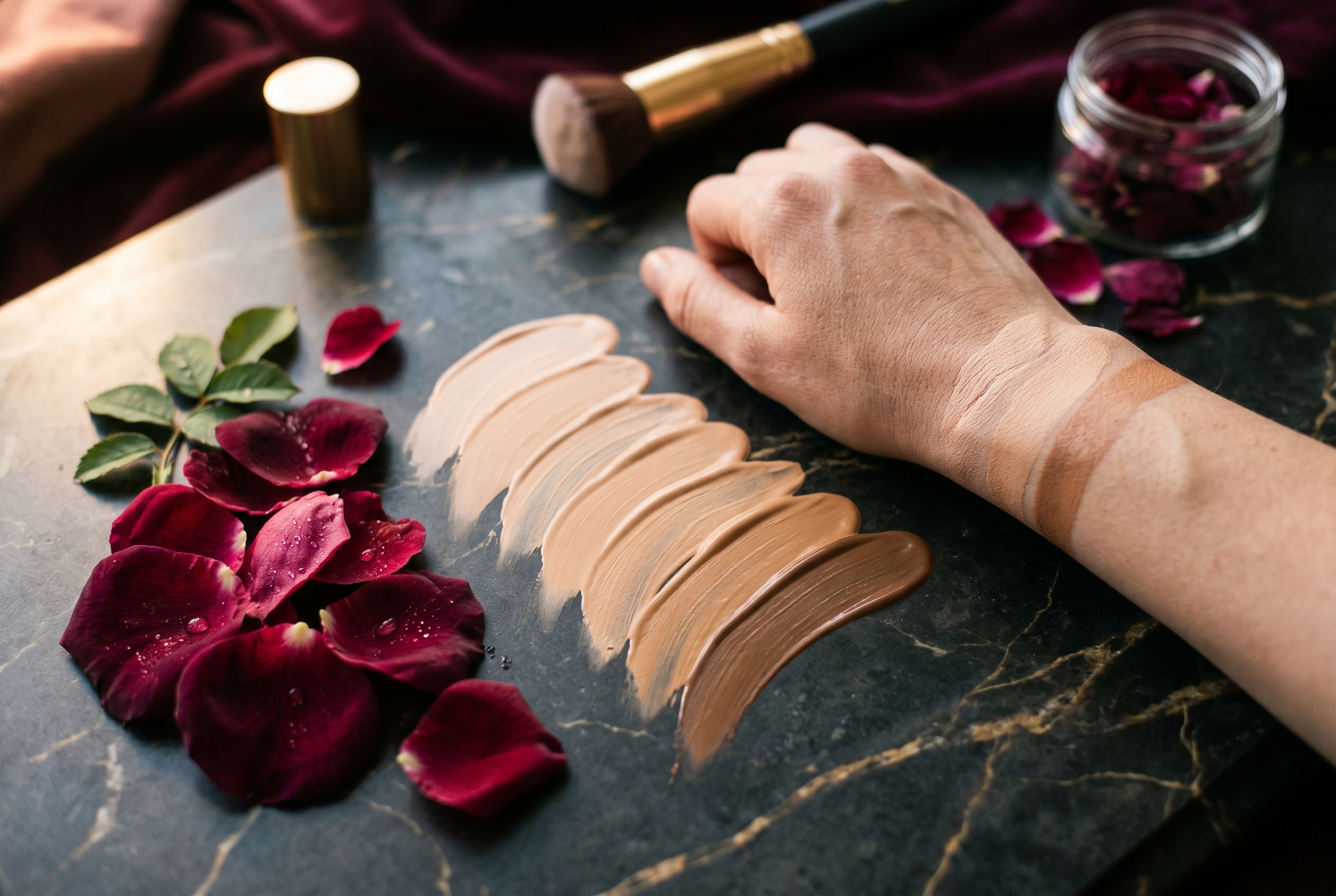
The Quiet Intelligence of a Perfect Match
There is a particular kind of confidence that arrives when foundation disappears into the skin. No demarcation at the jaw, no greyish cast under morning light, no warm-pink shift by late afternoon. Just complexion — yours, refined. Achieving this is less about luck than literacy: learning to read your skin the way a perfumer reads a rose. Foundation shade matching is, in essence, an act of self-observation, and once mastered, it becomes one of the most rewarding rituals in a considered beauty routine.
Begin with Undertone, Not Colour
The most common error in choosing foundation is fixating on depth — light, medium, deep — before considering undertone. Undertone is the quiet hue beneath the surface of the skin, and it remains constant whether you are sun-kissed in July or porcelain-pale in January.
The Three Classical Undertones
- Cool: Skin reads pink, rosy or bluish. Veins at the inner wrist appear blue or purple. Silver jewellery tends to flatter more than gold.
- Warm: Skin carries golden, peachy or yellow notes. Veins look greenish. Gold jewellery sits beautifully against the complexion.
- Neutral: A balance of both, with veins that appear blue-green and an equal affinity for silver and gold.
An olive undertone, often misread as warm, sits within the neutral family with a subtle green cast that requires its own careful matching. If you have ever tried a foundation that looked correct in the bottle yet turned ashen or jaundiced on the skin, undertone — not depth — was almost certainly the culprit.
Reading Depth with a Discerning Eye
Once undertone is identified, depth becomes the next consideration. Depth refers to how light or dark the skin reads on a value scale, independent of warmth or coolness. Most maisons categorise foundations from fair through to deep, with several gradations between.
To assess your depth honestly, observe your skin in natural daylight, ideally near a north-facing window where light is even and uncoloured. Avoid bathroom mirrors lit by warm bulbs; they flatter, but they mislead. Take note, too, that most complexions are not a single shade. The forehead may be a touch deeper, the centre of the face a shade lighter, and the décolletage often tells the truest story of all.
The Jawline Test — and Why It Still Matters
The classic technique remains the most reliable. Apply three potential shades in vertical stripes along the jawline, blending each gently downward toward the neck. The shade that vanishes — that you cannot find again without searching — is your match.
A foundation should never sit on the skin. It should converse with it.
Resist the temptation to test on the inner wrist or the back of the hand; both are typically a different tone from the face. The jaw and neck are where the truth lives.
Considering Finish, Coverage and Light
A perfect shade in the wrong finish can still feel disharmonious. Consider how you wish your skin to behave in light:
- Luminous finishes reflect light softly, lending a sensorial, lit-from-within quality suited to drier or mature complexions.
- Satin finishes sit in the elegant middle ground — neither matte nor dewy — and tend to flatter most skins.
- Matte finishes absorb light, offering refinement to oilier skins, though they can read flatter under certain lighting.
Coverage, too, plays a role in perceived shade. A sheer formula will lean closer to your natural tone, while a fuller coverage foundation must be matched with greater precision, as any mismatch becomes more visible.
Seasonal Shifts and the Two-Shade Wardrobe
Skin is not static. Many find that their complexion deepens by half a shade or more during summer months, and that undertone can shift subtly with sun exposure. The most considered approach is to keep two foundations — one for the cooler months, one for warmer — or to invest in a shade adjuster, a few drops of which can warm or deepen a base by degrees.
Common Pitfalls to Avoid
- Choosing a shade lighter to appear brighter — this often results in an ashen or grey cast.
- Choosing a shade deeper to mimic a tan — this tends to read muddy at the hairline and ears.
- Ignoring oxidation: some foundations deepen on the skin within twenty minutes. Always wait before deciding.
When in Doubt, Trust the Neck
If a single principle distils this entire art, it is this: foundation should match the neck, not the face. The face often carries redness, pigmentation or unevenness that we instinctively wish to correct, but matching to those irregularities only creates new ones. A foundation that meets the neck in seamless agreement is a foundation that has been chosen well.
A Final Reflection
To find one's foundation is to arrive at a quiet kind of intimacy with one's own skin — its rhythms, its warmth, the way it catches the morning. At VE RED RAZ, we believe beauty begins not in concealment but in attentiveness: the same attentiveness with which a Damascena rose is gathered at dawn, petal by petal. May your match, when you find it, feel less like cosmetics and more like coming home to yourself.