Paskelbta 2026 m. gegužės 11 d.
Foundation Shade Matching: The Refined Art of Reading Your Undertone
A considered guide to foundation shade matching, decoding undertones and finding a complexion finish that feels weightless, luminous and entirely your own.
- foundation shade matching
- undertones
- complexion
- luxury beauty
- makeup guide
- skin tone
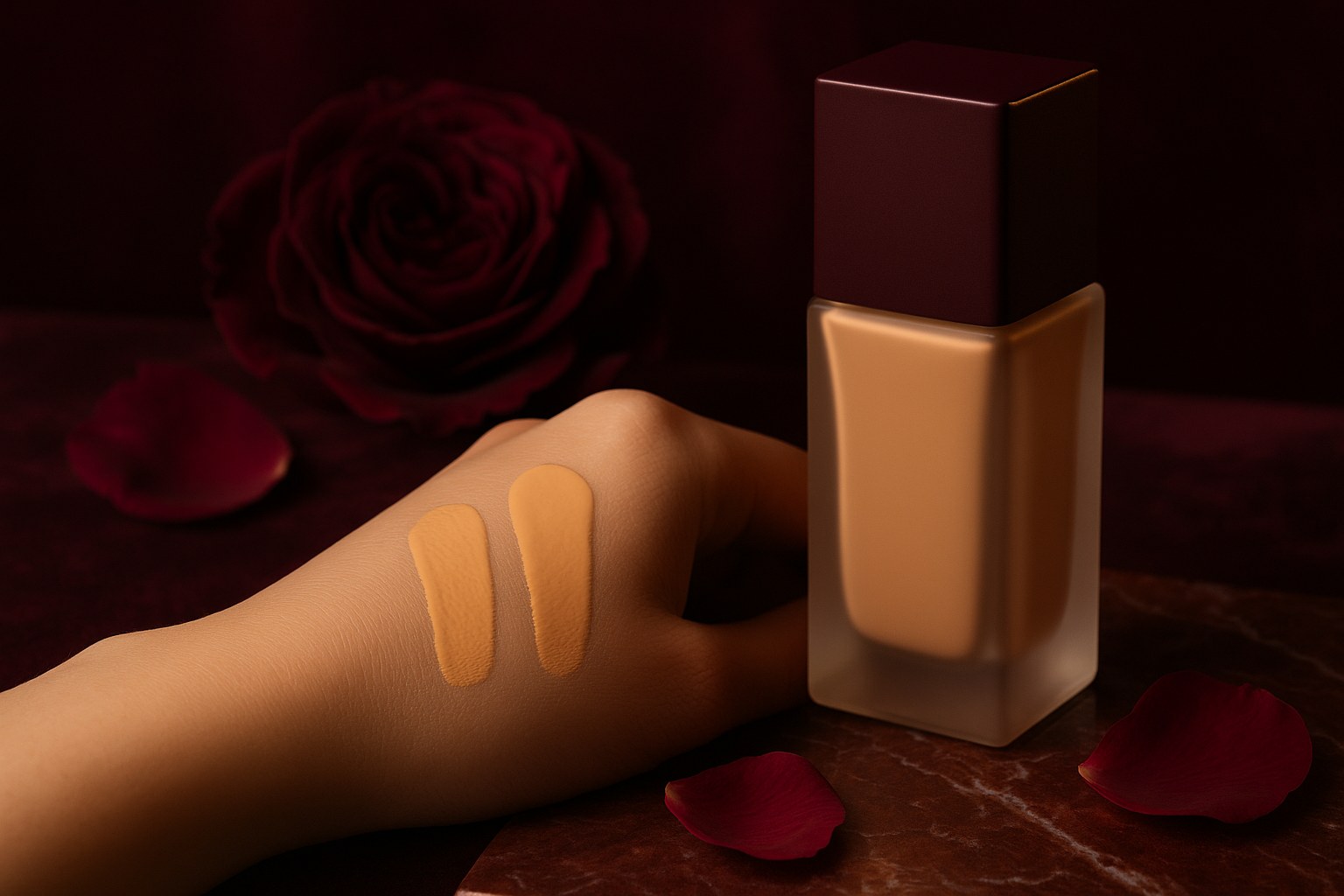
There is a quiet alchemy to a foundation that disappears into the skin. It is not the shade that flatters most loudly, but the one that seems to have been there all along — softening, evening, illuminating without announcement. The secret, almost always, lies in the undertone.
At VE RED RAZ, we approach complexion the way a perfumer approaches a base note: it is the foundation upon which everything else unfolds. Here, then, is a considered guide to foundation shade matching, written for those who prefer precision to guesswork.
Surface Tone Versus Undertone
Before selecting a shade, it helps to distinguish between two qualities that are often conflated.
- Surface tone is the depth of your complexion — fair, light, medium, tan, deep — and shifts with sun exposure and season.
- Undertone is the constant beneath: the quiet temperature of your skin that remains unchanged whether you have spent a winter in Vienna or a summer along the Côte d'Azur.
A foundation may match your surface tone perfectly and still appear wrong — ashen, sallow, faintly orange — if the undertone is misread. True shade matching honours both.
Identifying Your Undertone
Undertones fall broadly into three families: cool, warm and neutral. Olive, often spoken of as a fourth category, sits within the neutral family with a subtle green cast.
The Vein Test, Refined
Examine the inside of your wrist in natural daylight, never under artificial light, which distorts pigment.
- Blue or purple veins suggest a cool undertone.
- Green or olive veins indicate warm.
- A blend of both points to neutral.
The Jewellery Test
Consider which metals flatter you most. Silver, platinum and white gold tend to favour cool undertones; yellow gold and brass illuminate warm skin; rose gold often suits neutrals. If both silver and gold feel at home, you are likely neutral.
The Sun Response
How does your skin behave in sunlight? Cool undertones often burn before tanning. Warm undertones bronze readily. Neutrals do a little of both, with grace.
Undertone is not a trend. It is the quiet truth of your skin, and it deserves to be honoured rather than corrected.
Translating Undertone into Shade Selection
Once you have identified your undertone, the language of foundation becomes far easier to read. Most maisons use coded descriptors:
- Cool shades are often labelled with hints of pink, rose, porcelain or beech.
- Warm shades lean toward honey, amber, golden, caramel or sand.
- Neutral shades may be described as buff, nude, beige or simply neutral.
- Olive shades carry a whisper of green, designed to neutralise redness and preserve the skin's natural depth.
The Jawline Swatch, Done Properly
The back of the hand is rarely the same shade as the face. For an honest reading, swatch three shades vertically along the jawline, blending each lightly downward toward the neck. The correct shade should dissolve entirely — neither floating above the skin nor leaving a demarcation at the jaw.
Allow the foundation to settle for several minutes. Many formulas oxidise on contact with skin, deepening or warming slightly. A shade that appears perfect immediately may shift by the time you reach daylight.
Always Assess in Natural Light
Boutique lighting, however flattering, is rarely truthful. Step toward a window, or briefly outdoors, before committing. Daylight is the only honest mirror.
Seasonal Adjustment
Skin is not static. A considered wardrobe of foundation often includes two shades — one for the paler months and one for the warmer — blended together in transitional seasons to create an exact match. Think of it as you might a fragrance wardrobe: nuanced, responsive, attentive to mood and moment.
Finish, Texture and the Final Impression
Shade is only part of the equation. The right undertone in the wrong finish can still feel discordant. Consider:
- Luminous finishes flatter mature or dry skin, lending a dewy translucence.
- Satin finishes suit most complexions and read as polished without heaviness.
- Matte finishes bring quiet sophistication to oilier skin, though they can emphasise texture if applied with a heavy hand.
Always apply with a light touch. A foundation that has been correctly matched requires very little to perform beautifully — often a few drops, warmed between the fingertips, pressed gently into the centre of the face and diffused outward.
When the Match is Right
You will know. There will be no line at the jaw, no chalkiness in photographs, no warmth that drifts toward orange under evening light. The skin will simply look like skin — refined, quietly luminous, entirely yours.
At VE RED RAZ, we believe that beauty begins with attention. Knowing your undertone is not a small thing; it is a gesture of respect toward the canvas you wear every day. Once understood, the rest follows with ease — colour, fragrance, gesture — each layered upon a complexion that finally feels at home with itself.